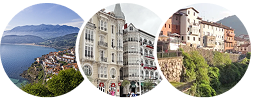


Discover an amazing diversity of landscapes, culture, food and wine following the Camino de Santiago
Discover the Way of St James, in Spanish the Camino de Santiago, in comfort, staying in delightful small hotels, and at your own pace with our self-drive touring itineraries.
Our Camino de Santiago touring holidays are ideal for those who want to explore the pilgrim routes, for their great natural beauty and rich heritage, but don’t want to walk the whole route or sleep in pilgrims’ hostals!
Camino de Santiago - so easy to get to...
Numerous flights from the UK to North Spain and North Portugal and seven ferries a week to Spain mean that the Camino de Santiago route has never been easier to get to.
- Direct flights to Bilbao, Santander, Asturias, La Coruña, Porto or Santiago make point-to-point touring in north Spain and Portugal easy. Follow the Camino del Norte, the Camino del Frances or the Camino Portugues or combine all three into a round tour…
- Independent self-drive touring with all the info and support you need
- Bespoke itineraries – designed and organised by our experts
- Fly to Spain or Portugal and we’ll include a car or bring your own vehicle and we’ll build in the ferry.

Explore our favourites Camino-based tours in Spain & Portugal
Here's a selection of our Camino-based tours - use our interactive search for a full list of Camino de Santiago driving tours


Practical Information
Camino de Santiago – The Way of Saint James
For centuries Santiago de Compostela in Galicia, the north-western region of Spain, has been one of the major European pilgrimage destinations.
In medieval times the journey might have been quite an ordeal but the amazing scenery, outstanding heritage, food and drink and the welcoming people, these days make it an ideal destination for touring holidays.
Enjoy our ‘Caminos’ self-drive itineraries at your own pace in the comfort of our hand-picked hotels and discover the beauty of the lesser-known regions of Spain & Portugal.
Camino de Santiago
The legend of St James in Iberia
In the year AD 40, whilst spreading the word of Jesus throughout the Iberian Peninsula, the Virgin Mary appeared to the apostle St James atop a pillar in what’s now know as Zaragoza. An immense Cathedral now stands on this site in veneration of the Virgen del Pilar to whom a national holiday is also celebrated every 12th of October.
Shortly after, St James returned to Jerusalem where he was promptly beheaded with a sword by King Herod himself. The legend holds that his body was taken up by angels and sailed in a rudderless, crewless boat from Jerusalem to Iria Flavia (nowadays Padron) in north west Galicia, where a massive rock closed around his relics, which were later removed to Compostela.
Eight centuries passed without incident until, in the early days of the Reconquista, the shepherd Pelayo, led by a star, discovered the remains of the saint – from this, some say comes the name Compostela, a derivation of the Latin Campus Stellae.
In 844 Santiago further reinforced his status among the Spanish Christians by appearing on a white charger in the guise of Santiago Matamoros (moor-slayer) and leading them to victory in battle at Clavijo. The people vowed to pay a tribute to the Saint should the Reconquista be successful, a promise which they fulfilled, continuing to pay the tax into the early 1900’s – which in part explains the enormous wealth held by the Cathedral and City of Santiago.
It wasn’t all roses however, in 997 Al Mansur captured the city and carried the huge bells off to Cordoba where he turned them upside down and used them as oil containers – they weren’t to return until 1236!
The second millennium
Throughout the 9th and 10th centuries a succession of ever larger churches were built on the site and the pilgrims started to arrive in their hordes. Towards the end of the 12th century the Pope decreed Santiago to be a holy City, on a par with Rome and Jerusalem.
Centuries pass, the Reconquista is won, glory days for the Camino and then, in 1589, with Drake, the English pirate, attacking the Galician coast, the remains are hidden away for safety – the only problem being that afterwards nobody can remember where! No matter, business carries on as usual but then, nearly three hundred years later and with numbers dwindling, the bones miraculously show up again!
Although this helped somewhat, the Camino continued its fall into decline right through to the 1980’s. Since that time however it has enjoyed a significant resurgence in popularity with over 327,000 registered pilgrims last year (2018) (272,000 the last time a holy year was celebrated in 2010). In 1985 the city of Santiago de Compostela was included in the UNESCO’s World Heritage Sites and in 1987 the Camino de Santiago was considered the first European Cultural Itinerary by UNESCO.
Camino del Norte – Northern Way to Santiago
Starting very close to the French border, this camino covers the whole of the coastal regions of Northern Spain.
A one-way itinerary or circular tour, you can get as active as you like, a great mixture of tranquil beaches and high mountains, this region has something for everyone.
Experience the Camino del Norte through our northern Spain tours.
When to come
The northern, more verdant, regions of Spain receive more rain (and even snow in the mountains) but the summers are very pleasant, usually not surpassing 35º.
In winter the high mountains’ tops are snow-capped for most of the season.
Anytime from mid-May through to mid-October is a good time to travel on the Camino del Norte.
Getting there
Take a ferry from the UK or Ireland to northern Spain and enjoy holidaying with your own car or motorbike. Six crossings from the UK and two from Ireland.
Or fly to Spain rent a car or motorbike, we can offer rental car pick-up at the airport in Bilbao, Santander, Asturias and Santiago and motorbike rental is available in Bilbao.
Camino del Frances – French Way to Santiago
The quintessential of the caminos, northern Europeans have used this path for centuries on their way to Santiago, crossing the French-Spanish border in the Pyrenees mountains. It can be one-way or circular.
This path travels straight through the regions of Rioja, Burgos, Leon and Galicia, all regions of great historic importance, boasting architectural gems like cathedrals and churches.
When to come
The inland regions of Spain enjoy a benign climate with milder winters and dry summers in the lower valleys and coast, and fresher temperatures in the mountains and high plains.
Getting there
Take a ferry from the UK or Ireland to northern Spain and enjoy holidaying with your own car or motorbike. Seven crossings from the UK and two from Ireland.
Or fly to Spain rent a car or motorbike, we can offer rental car pick-up at the airport in Bilbao, Santander, Asturias and Santiago and motorbike rental is available in Bilbao.
Via de Plata – Inland Spain Way to Santiago
Andalucia is the beginning of this way which crosses the whole length of the Iberian Peninsula from south to north, all the way to Santiago.
Heritage cities, architecture and history describe the centre regions of Spain, from Roman to contemporary art, arid planes and mountain ranges.
Perfect for spring and autumn holidays, this could be a one-way or a circular route.
When to come
Crossing Spain from South to North (or vice versa) through three distinct climate bands, this epic trip needs careful planning to achieve the best compromise and make the most of the journey.
At the southern end, in Andalucia, temperatures often reach over 40º in the summer, the central region can also be blisteringly hot in summer and harshly cold in winter, whilst the north coast has a cool maritime climate, normally best avoided in winter.
You're guaranteed a wide spectrum of weather whatever time you come but in Spring and Autumn the temperatures should be quite pleasant throughout the trip.
Getting there
Though one variant joins the Camino del Frances and links with Santiago, our IC1 Via de Plata tour follows the ancient Roman trading route from Gijón in the north to Sevilla (or Cádiz) in the south.
Fly into Santander, Bilbao or Asturias and back from Sevilla or Málaga - see Travel details on the tour for more info.
Should you wish to come by ferry we can easily interleave the stops to make an out-and-back itinerary or add a couple of stops to travel back through central Spain (e.g. via Toledo, Segovia, Burgos...)
Camino Portugues – The Portuguese Way to Santiago
Start in Lisbon and travel north, crossing the border to Spain and Santiago.
Discover northern Portugal, small but endlessly captivating, rich with delightful regional contrasts, is the ideal destination for a wonderful touring holiday.
Please note; if renting a vehicle, this route should be designed to be circular, as rental cars must be returned to their country of origin.
When to come
Following the Atlantic coast of Portugal and Spain the Camino Portugues (Portuguese Way of St James) has the most benign climate of all the 'ways'.
Though the winter months are best avoided the weather should be pleasant at any time from April through to October. If taking the longer route, starting in Lisboa, the summer months can be quite hot and might be best avoided.
Getting there (and around)
Fly to Porto or Lisboa from most UK airports - see the 'Travel details' sections of the tours.
As the hire car needs to be dropped of in the same country where it was collected both of our Camino Portugués tours are designed as 'out-and-back' itineraries.
Our Porto to Santiago tour starts and finishes in Porto (or Santiago).
The longer Lisboa to Santiago tour starts in Lisboa and finishes in Porto (though you can, of course, return to Lisboa should you prefer).
Why our clients love our tours
Your satisfaction is our Nº 1 priority – read independent reviews of our holidays on AITO.com
Check out our travel guides
No item found!